
As the world becomes more open to discussing mental health, more people feel empowered to get treatment for mental health conditions. While medication is (and will always be) an option, some people naturally prefer trying chemical-free treatment methods.
Neurofeedback therapy is one of these methods. Anchored in biofeedback principles, neurofeedback therapy trains the brain, empowering it to regulate its own activity.
How Is Neurofeedback Therapy Performed?
Neurofeedback therapy takes place as multiple sit-down sessions at a neurofeedback therapy institute. Before the actual sessions, however, there must first be a consultation and brain mapping.
Step 1: Consultation
During the consultation, you sit down with a therapist to share your concerns or what you want to accomplish (i.e., the reason you booked a consultation). They’ll ask questions to help surface your symptoms and aid them in assessing your condition.
Step 2: Brain Mapping
Next, you’ll undergo brain mapping. This essential step lets the therapist peek into your brain activity, understand how your brain functions, and detect any dysregulated brainwave activity and patterns.
Do you have attention-deficit/ hyperactivity disorder (ADHD), an anxiety disorder, or depression? A therapist will look at your brainwave activity data to evaluate your condition.
Brain mapping also provides your therapist with baseline data to work with. It allows them to identify the issues they must resolve through brain training and to use it as a reference point for assessing progress, especially after multiple neurofeedback therapy sessions.
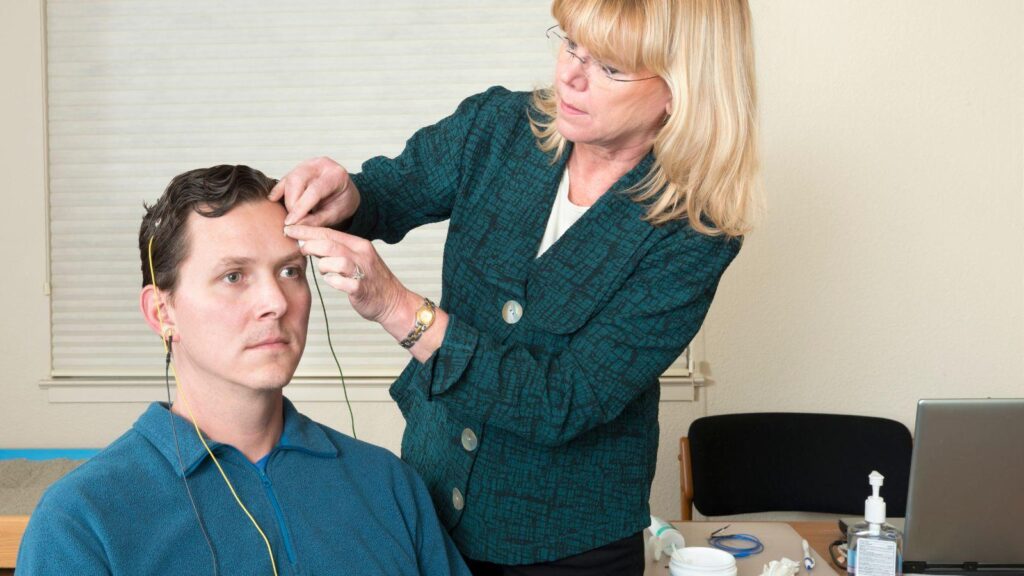
To perform brain mapping, the therapist attaches electroencephalogram (EEG) sensors to predetermined spots on the scalp. While the sensors are attached, the therapist may ask you to perform some tasks, such as opening or closing their eyes, doing a math calculation, or performing some hand movements.
After the brainwave activity assessment, the therapist can create a neurofeedback therapy plan, summarize their recommendations, and proceed to the next step.
Step 3: Neurofeedback Therapy Sessions
In a neurofeedback therapy session, you’ll be given headphones and a comfortable place to sit in front of a TV monitor.
EEG sensors will be attached to your scalp, just like they were during the brain mapping session. Then, you will spend the rest of your time watching a movie or a TV show.
The EEG sensors are connected to a computer that monitors and logs brainwave activity. It feeds your brainwave data to a program, which detects and classifies brainwave patterns as dysregulated (i.e., problematic) or regulated (i.e., desirable). Each option triggers a change in the audio and video quality of the movie or show you’re watching on TV.
If the program detects dysregulated brainwave patterns, it will diminish audio and video quality, so you will get inaudible dialogue and a blurry picture. If the program perceives desirable brainwave patterns, it will enhance the audio and video, so you will enjoy richer sounds and crisper definition.
This will repeat throughout your session. Dysregulated brainwave activity? Poorer-quality audio and video. Desirable brainwave activity? Clearer sound and picture.
Step 4: Assessment
Your therapist will monitor your progress during the treatment period. At a later stage, they will conduct another brain mapping session and additional assessments to compare the results with your baseline data.
After several sessions, they will perform an assessment of your overall progress. How much better are your brainwave patterns now compared to how they were before you started therapy? They’ll also ask you questions to gauge how your condition has improved and understand how you’re experiencing the changes.
If they think there’s room for further improvement, they will recommend continuing neurofeedback sessions.
The Mechanism of Neurofeedback Therapy
How and why does neurofeedback work? As mentioned earlier, neurofeedback is a specific application of biofeedback principles.
Biofeedback refers to attaching sensors to the body to track involuntary bodily functions like breathing and heart rate, then letting you know about them in real time (as they happen) so you’re aware and can actively and consciously regulate them. Biofeedback ultimately allows you to control otherwise automatic processes.
Neurofeedback is a specific variant of biofeedback. In this case, you’re tracking brainwave activity (instead of your heart rate), making your brain aware of it in real time, so it can consciously regulate it.
Neurofeedback therapy works through repetition. Over time, as you go through multiple neurofeedback sessions, your brain becomes more aware of its own activity, enabling it to self-correct; that is to say, to switch from a dysregulated to a regulated state.
How long does it take to train the brain? It varies from person to person, but most people can expect to see changes after six or seven neurofeedback sessions (or even earlier).
Is Neurofeedback Therapy for You?
Neurofeedback therapy is a brain training method that can be used to treat or manage many conditions, including ADHD, anxiety, depression, stress disorder, and anger management issues. Brain training can also be used to improve memory, manage stress, achieve peak brain performance, and provide migraine relief.
Consider neurofeedback therapy if you want a non-invasive, medication-free approach to treating any of the above conditions or empowering your brain to achieve a desired outcome.